The Crossing Where She Looked Back
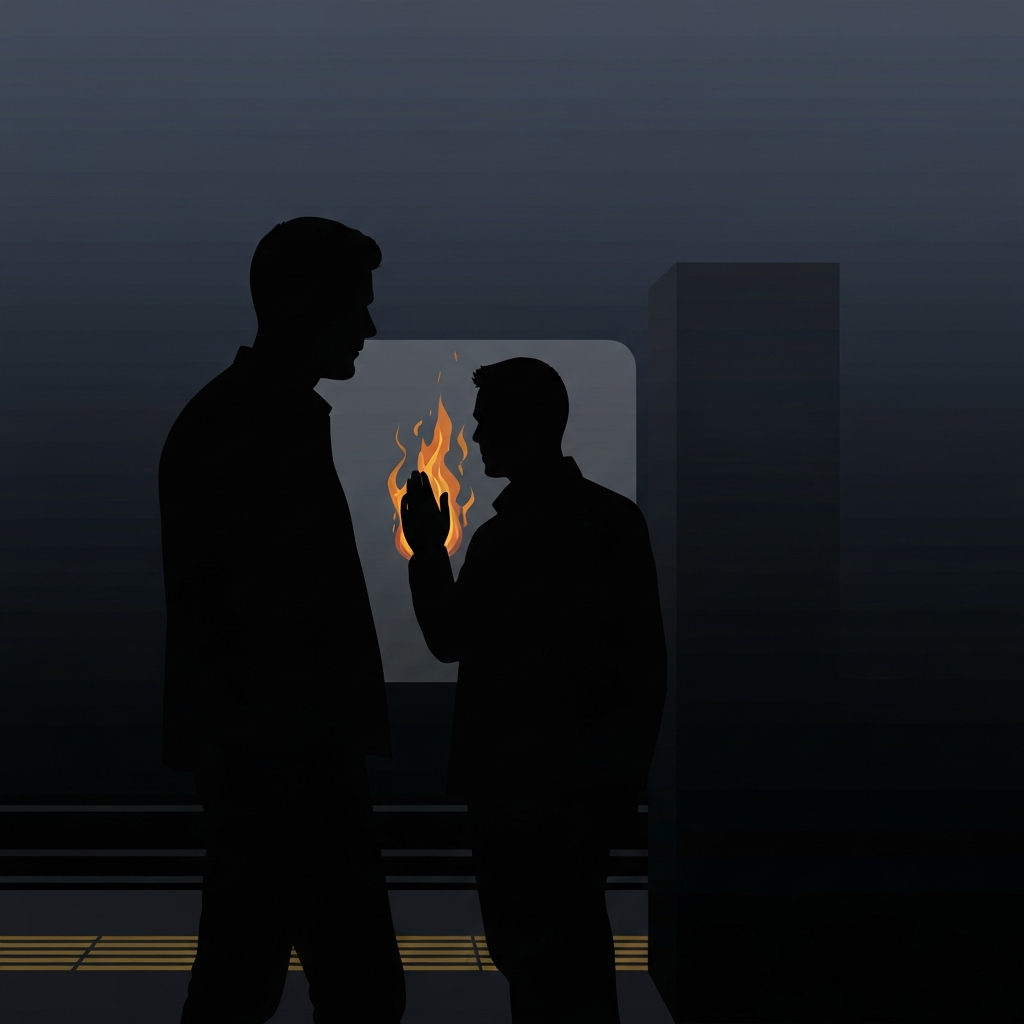
11:47 p.m. last night, Exit 5 of Gangnam Station, Line 2. Reflected in the glass façade, a woman’s eyes met Jeong-hyun’s. A long braid, a black mask, the sliver of skin above her jeans where her sweater rode up.
‘She looked at me. Or did I only imagine it?’
The moment he averted his gaze, she turned her head too—simultaneously. Like two watches striking 11:47:23 in perfect sync. A collision lasting 0.8 seconds.
In that blink, Jeong-hyun had already pictured their first kiss, first quarrel, first goodbye. He heard the sound of half his chest collapsing.
Desire Refuses to Be Flattened
Men in their thirties know this: love can be engineered from start to finish. While idling on a studio-sofa bingeing Netflix, while commuting home, even while clapping politely at a friend’s wedding. One look from an unfamiliar woman and everything feels possible again.
She saw me. She definitely saw me.
But this isn’t love. It is the weight of an unverified possibility—the deferred compensation for attention he never received in youth. The day sophomore year when first-love Ji-su smiled at another guy. The day a woman who’d locked eyes with him on the morning train stepped off without a backward glance. All those small losses bred today’s hunger.
A thirty-something man’s gaze-lust differs from raw sexual craving. It is an exam he keeps failing: Will any woman look at me until the very end?
Sangam-dong, Park Jun-ho’s Fourteen Days
Park Jun-ho, 33, product manager at a gaming company. An ordinary day. 7:30 a.m., Exit 9 of Digital Media City Station, Sangam. Then it happened.
A woman in a black shearling coat stared through his back as if he were a transparent phone screen.
‘Does she know me? Or is it—’
She approached. Three seconds, five, seven. Jun-ho’s heart tore in two directions: the urge to bolt, the feet rooted to concrete.
The woman spoke.
- “Excuse me… didn’t we meet once in Gangnam ages ago?”
A lie. Jun-ho had never seen her in Gangnam or anywhere else. Yet he nodded.
For the next fourteen days he met her—fogged-window cafés, her questions never asked, her gaze steady and smiling. On the fourteenth day she vanished. No Kakao, no call, no Instagram. As if the original meeting itself had been a fabrication. Jun-ho still cannot forget that look. No—he refuses to forget it.
Incheon, Choi Min-jae’s Calculated Coincidence
Choi Min-jae, 35, junior accountant. A planner by nature. For six months he had been “accidentally” passing the same woman at Exit 2 of Dongincheon Station, Line 1, at the same hour. The first time was chance; after that it was design.
She wore the same black suit, held a pen in her left hand, carried the same black Americano in her right.
Min-jae never met her gaze directly. He stood at a 45-degree angle, watching her reflection in a mirrored pillar.
‘She looked today. At me—or at least pretending to.’
On the hundredth day he stepped forward.
- “I see you every morning.”
- “I know.”
Her reply was almost too simple, as if a hundred days of silence could be resolved only this way. They had lunch. Her name was Seo-yeon, studying for the bar exam. Min-jae confessed he had watched her for a hundred days. Seo-yeon didn’t flinch.
- “I felt it. Every day.”
From that day on Min-jae never saw her again—not at Exit 2, not anywhere. As though a hundred days of mutual gaze had exhausted them both.
Where Does the Taboo Take Root?
The reason thirty-something men are lured by a stranger’s gaze is simple: boredom with a life already validated. Studio-apartment deposits, org-charts, salary negotiations, parents’ annual check-ups—all promise a future too clearly mapped.
A stranger’s gaze is different. It is the single variable that can twist the future off its rails.
Psychotherapist Esther Perel says desire breeds the terror of loss. Men in their thirties have already lost plenty—first love, youth, the luxury of helplessness. They feel they have nothing left to lose. That is the delusion.
What they truly stand to lose is the accumulated weight of everything they have built. A stranger’s gaze can make that weight feather-light in an instant—then the lightness hardens into crushing obsession.
Do You Still Look Back?
Right now, where are you standing? The subway home, a one-room with a single can of beer, or applauding at a friend’s wedding? While reading this, perhaps you remembered someone’s eyes—on the train, in a café, on a random street—and how that glance opened a door of possibility.
But remember this:
When that gaze reached you, did you truly want love? Or did you only want the unverified possibility of yourself?