Seven Seconds of Breathlessness: a Black Screen on the Breakfast Table
Kim Hyun-su’s chopsticks hovered in mid-air. Morning light pooled across the table; an untouched tablet lay face-down, still locked. In the dark glass he saw his own bloodless face and, behind it, the silhouette of Ji-woo approaching.
This morning, a single link in an Instagram DM. “Is this your daughter?” the message asked, nothing more.
Until he tapped it, he dismissed it as spam. The moment the file opened, Hyun-su’s lungs hardened like pills. On the screen was his daughter’s face, beneath it an expression he had never seen: a smile tugging at one corner of her mouth, her head half-turned, eyes fixed on something beyond the frame. It was not Ji-woo, yet it was unmistakably Ji-woo.
Father’s Eyes, Eyes That Are No Longer Father’s
Hyun-su flipped the tablet over. The screen refused to die. In the glossy black his pupils doubled, and inside them his daughter seemed to keep smiling. For the first time he felt his gaze fork in two.
This path is the father’s eye. That path is the man’s eye.
Between them hung a black silhouette. For twenty-five years the outline had set under the name father. Now one AI-born shadow rattled it. Hyun-su realized he had never truly seen even a single shadow cast by his daughter.
Sitting on a Closed Toilet Lid: Jin-hyeok’s Night at Fifty-Two
Lee Jin-hyeok (pseudonym, 52) sat on the closed lid of a company-stall toilet. Fluorescent light blinked its pale eyelid in the narrow cubicle. He took out his phone. Inside the dark screen his daughter’s face laughed under an alien moon. He flicked the glass with a finger; the smile did not waver.
“Who would do this…”
After discreet inquiries he met the twenty-something who had made it—outside a pharmacy, beneath the convenience-store glow. The young man’s pupils reflected the fluorescent tubes in duplicate; inside them, too, a black silhouette floated. Jin-hyeok forgot language for an hour, then spoke a single sentence.
“When you have a daughter of your own, you’ll understand.”
The youth answered only with a nod. The nod meant not I understand, but I don’t know either. At that moment Jin-hyeok grasped why he could not bring himself to rage: perhaps the shadow in the boy’s eyes was a future version of himself, an unspeakable complicity.
The Hidden USB: A 48-Year-Old Father’s Double Lock
Park Seong-woo (pseudonym, 48) secretly downloaded three more AI images of his daughter. He saved them on a black USB at the back of the bedroom drawer, then deleted every trace from the computer desktop. The USB had two locks: first the computer password, second the silent incantation in his mind—This is not my daughter.
Yet whenever he viewed them alone, the spell read backwards. Repeating This is only AI, not my daughter, his gaze dug deeper instead. Curiosity hissed like stifled laughter behind a locked door.
Birth of the Censor: The Name Father
Whose daughter are you?
Taboo always begins inside the father. He is the world’s first censor. The instant his daughter is born, he draws a border: This must not be seen. Over time the line hardens, yet paradoxically grows more transparent. AI holds that transparent border up like a mirror.
A mirror never tells the truth. It only returns your face to you.
Modern fathers fight on two fronts: the shadow they see of their daughter, and the shadow they hide. Between them lurks the father’s desire, not mere lust, but the terror of passage from mine to another’s, laced with an illicit thrill.
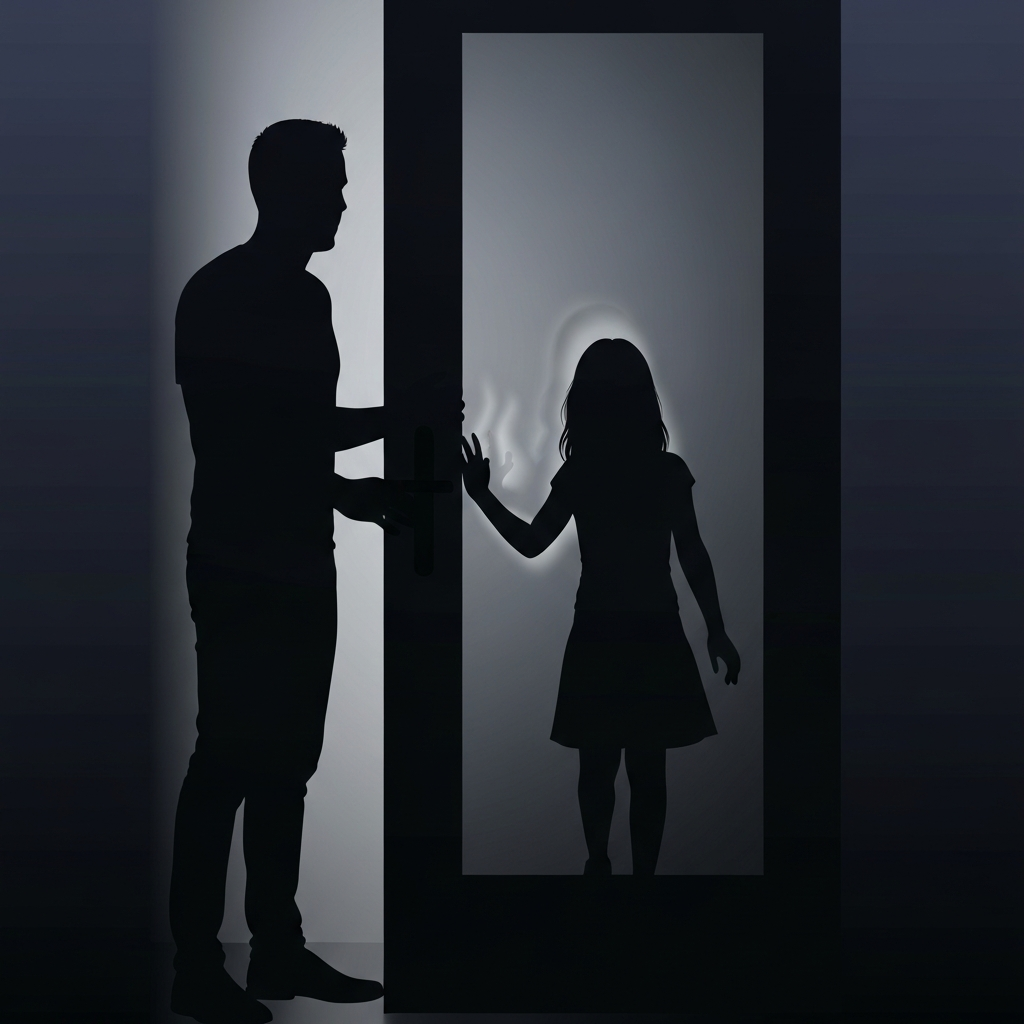
The Final Sentence: You, Standing at the Door
You stand at the door. Something trembles in the muted hush beneath your feet. The shadow AI conjured is not imprisoned on any screen; it is already etched deep inside your pupils.
Each morning when your daughter asks, “Dad, what should I wear today?” your gaze clutches the doorknob and shivers.
Close your eyes—the shadow remains. Open the door—the father’s eyes stay shut.
That is the loneliest war this era asks fathers to fight.