"Just sign." The words dropped onto the table like a stone. Ji-su pressed their ninety-two-day-old child to her breast. The baby gave a feeble, milky smile. The room carried the stale scent of formula mixed with breast-powder—an odor that had become foreign to her. Min-seok laid the divorce papers down, walked into the bathroom, and shut the door. No water ran. Ji-su knew he was staring at himself in the mirror.
A Broken Nipple
My body has become a parenting machine. For the first hundred days after birth Ji-su never removed her bra. 2 a.m., 5 a.m., 7 a.m. After the third day she stopped checking the clock. Each time the nipple touched the baby’s mouth an electric jolt shot through her, yet her chest felt hollow. The newborn had done nothing wrong, but Ji-su was afraid to meet its eyes; the child was simply trying to be fed. When the baby cried, Min-seok turned away. For the first two weeks he was visibly careful; then, while Ji-su latched the baby on, he opened the wardrobe, dressed, and left for work at seven. A single text—“night shift”—was all she received. Perhaps Min-seok was frightened too; the baby reflected his own helplessness back at him.
What No One Tells You: Case Studies in the Smell of Milk
Case 1: Da-hye, 29, baby 87 days old
I thought I couldn’t drink even one beer while breastfeeding, and that loneliness was worse than any prohibition. My husband ordered fried chicken for his midnight snack, popped a beer, and said, “Delicious.” When I complained my nipples hurt, he asked why I was being so delicate. That night I sat in the bathroom alone for thirty minutes hand-expressing milk. The sound of it hitting the tile was softer than the sound of me swallowing my sobs.
Case 2: Ye-rin, 34, baby 95 days old
My husband volunteered to give the baby its first bath; the child slipped and bumped its head. I ran over screaming and gathered the baby to me. My husband said, “Stop, you’ll scare it more.” After that he whispered “overprotective” whenever he saw me holding the child. I took the postpartum-depression diagnosis to him and he said, “That’s nothing special.” The divorce was already in motion before the baby reached one hundred days.
You Must Not Collapse in Front of the Baby
Society pins the word “recovery” onto the hundredth day postpartum, but it is not a return—only a severance. When parental leave ends, the office summons one parent, the daycare the other. Ji-su looked in the mirror and saw a woman reduced to “the baby’s room.” Min-seok came home at two every morning and left again at eight. When he entered, the baby forgot how to smile. Min-seok blamed that too: “The child is too attached to its mother.”
We could no longer endure one another’s pain. Min-seok likely lifted a glass at his company dinner and said, “My wife can’t stand the sight of me.” Ji-su probably posted anonymously in a mothers’ forum: “My husband has fled psychologically.” Words disassembled each of us in separate rooms until, on the ninety-second day, the papers arrived.
Why We Fall So Fast
What we wanted was not love but rescue. Postpartum divorce is not ordinary conflict. It is a collapse that occurs when two people confront the same vanished time. The baby demands twenty-four hours, the parents give themselves zero, and a hundred days pass. Desire shrinks to the minimum wish called “sleep.” Forget sex—holding hands feels like a threat. During the thirty minutes the baby sleeps, even each other’s breathing is an intrusion. We expected to be loved, yet we could not stop needing to be cared for. And the baby was simultaneously the one we must tend and the evidence that watched us. The more the child grew before our eyes, the sharper the brand of our parental failure became.
The Baby Lies on the Papers
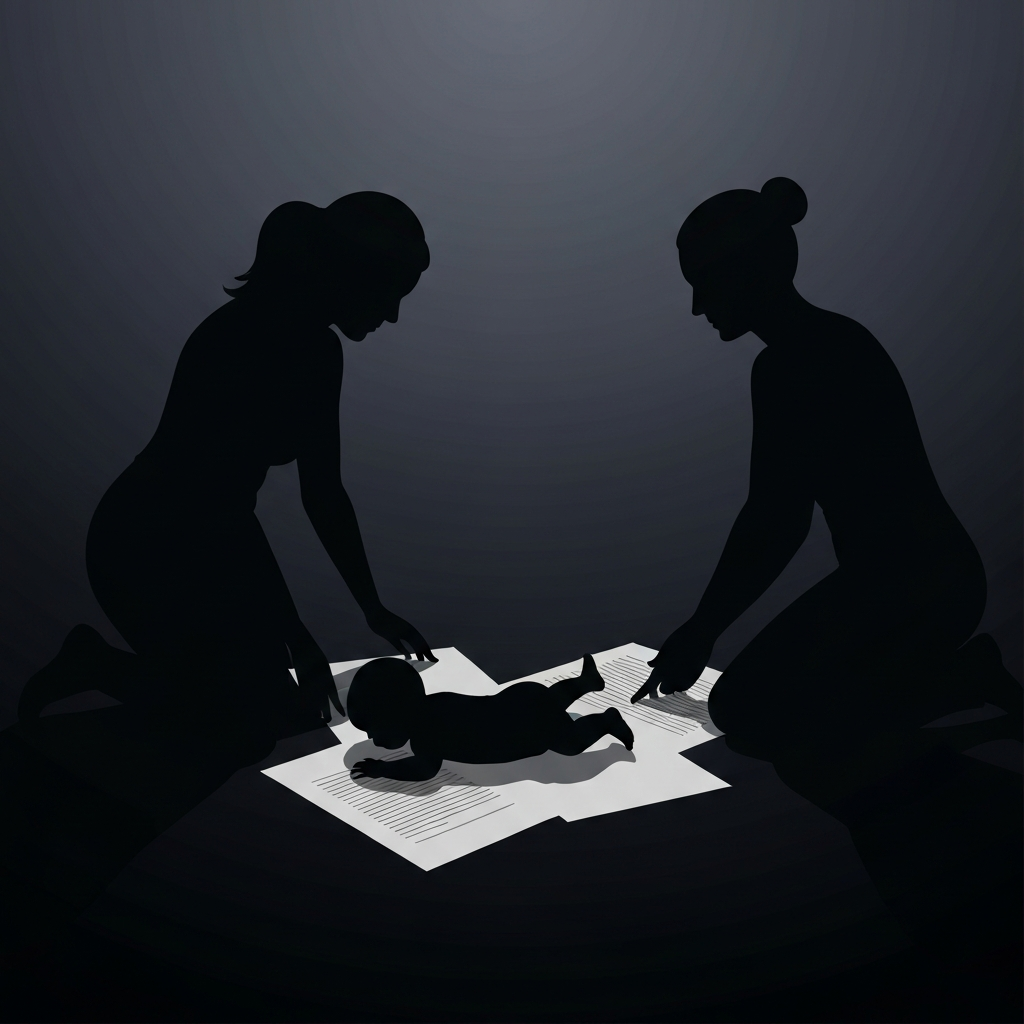
Ji-su lifted the pen. Min-seok had already signed. The baby lay on the divorce documents, kicking tiny feet at the air. Those feet will someday turn pages of their parents’ paperwork. In that moment Ji-su understood: even on divorce forms the baby cannot leave its mother’s arms. The instant we sign to separate, the child remains lodged between us.
When you hold those papers, will you meet your baby’s eyes—or will you hide forever?