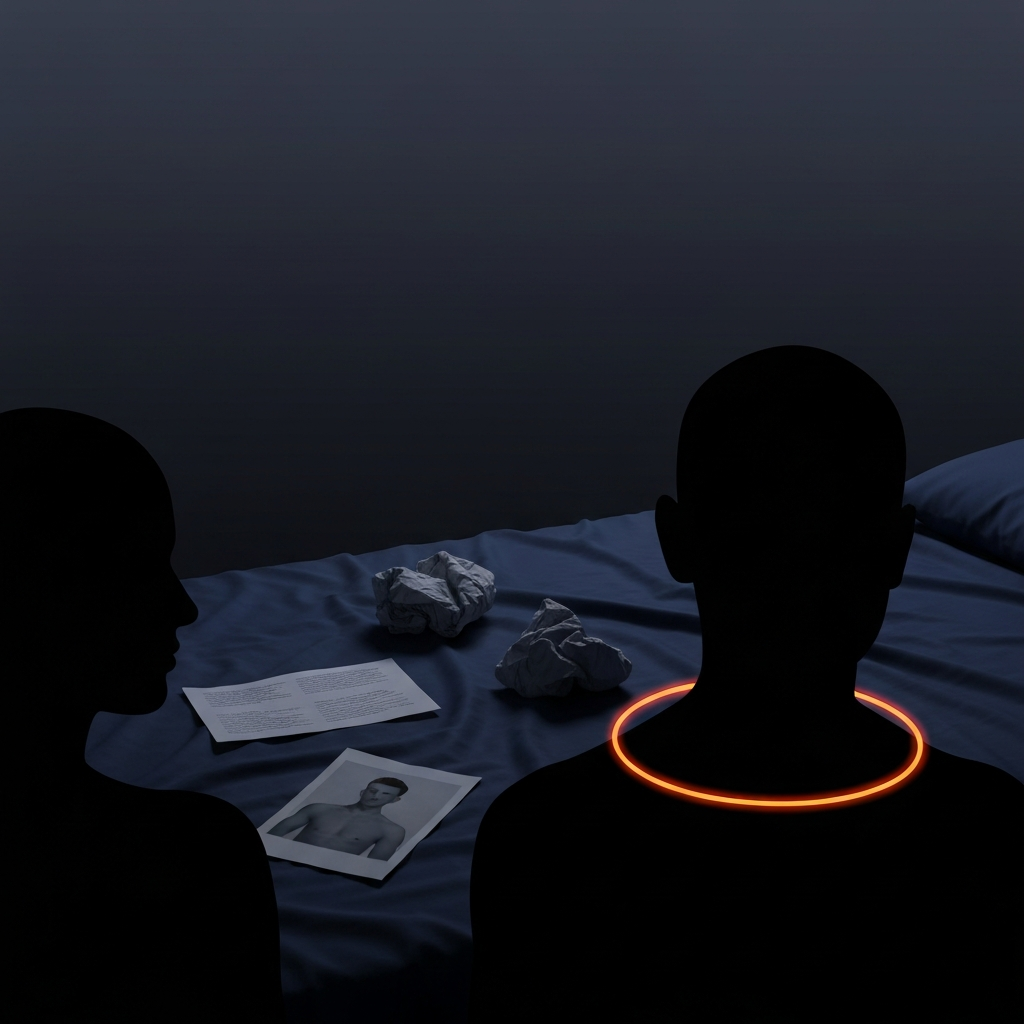
“Is this your bed?” The sheets in the photo are unmistakably the navy ones I chose, so why is the light blurred and bleeding? Focus smeared like fingerprints on glass, and in the haze a vivid flush blooms on my husband’s nape. The woman smiles over her glasses. I could swear I remember the edge of that bed against my bare skin. --- ## A single clipped fingernail speaks Lay one photograph atop a stack of divorce papers and the fluorescent glow of the office lamp seems to leak. The lawyer lowers his head; I vomit in the restroom, return, and uncap a highlighter. I draw an orange halo around the lip-print stamped on my husband’s neck. I decide this is the first thing that must be erased—not from the photo, but from whatever he sees before he dies. Adultery is never evidence; it is a quality-assurance certificate for lack. It does not say, You were insufficient; it insists, I overflowed. Thus the discoverer of evidence is immediately confronted with her own absence. > “What am I missing?” > > The soliloquy falls in shards. I already know the answer: the me who is no longer me, the me who became her. ## The bedroom smells of engine oil Case 1. Three months ago, Yuri tore a motel receipt from her husband’s wallet. On the back, a phone number. She texted: I know who you are. Four minutes later: So do I. Then she was blocked. Yuri thought that was the end. The next week a parcel waited at her door. Inside, a single photo of her husband’s back and a USB labeled with her name. Forty-seven seconds of footage: someone snipping single hairs from his sleeping head and collecting them. Yuri watched it twice. The second time was the night he came home, when she checked his hair in silence. Case 2. Seong-hyeon met her lawyer in a café near the courthouse. From her bag she produced her husband’s black jacket. Dried spit crusted the lapel. Lawyer: “Is this… evidence?” Seong-hyeon: “Not the spit—the smell.” Lawyer: “You can’t record a smell.” Seong-hyeon: “Take it. Sniff it. It’s just been dry-cleaned, yet it still reeks of a spring sea. My husband hates the ocean.” She asked the judge to smell the jacket. Denied. Instead she sealed it in an evidence bag and refrigerated it. A month later, when the salt-air scent turned to gas fumes, she turned on the kitchen gas and struck a match. The fire department’s call log reads only: The scent of his cologne is gone. --- ## Why are we haunted by evidence? Psychologists call it “the deferred death sentence of desire.” Each encounter with proof is another slow-motion suicide of a fact already dead. Only by repeating the murder can we finally whisper, It’s over. “When I see the evidence, I can believe I was a victim.” Perhaps that is why the photograph atop the divorce papers is not reality but proof that I still exist. My husband’s neck has left my body, yet the highlighter’s line still dangles from my fingertip. Adultery is simply the business of retrieving one’s lack from another. So we gather, rearrange, replay, and hurl the lack back. Only then might “sorry” seep out. > “I’m sorry—sorry you ever loved me.” --- ## Still no apology I slide the divorce papers to the back of the drawer and take them out every week. The fluorescent streak on my husband’s neck fades: orange to pale lemon, then to a color I can no longer name. In the end, a single photo, a sheaf of papers, and one highlighter serve not revenge but the perpetual proof that this is not over. So I wait. I still wait for the apology—no, for the single sentence: You are finished now. The sheets have changed from navy to beige, yet the blurred light of that night remains. If it were you, what light would you cast upon that photograph now?
2026-04-20
Adultery Evidence on the Divorce Papers: Still Waiting for an Apology
A fluorescent-highlighted married neck, divorce papers on the bed, and a photo of betrayal. She still waits for one word: sorry.
← Back