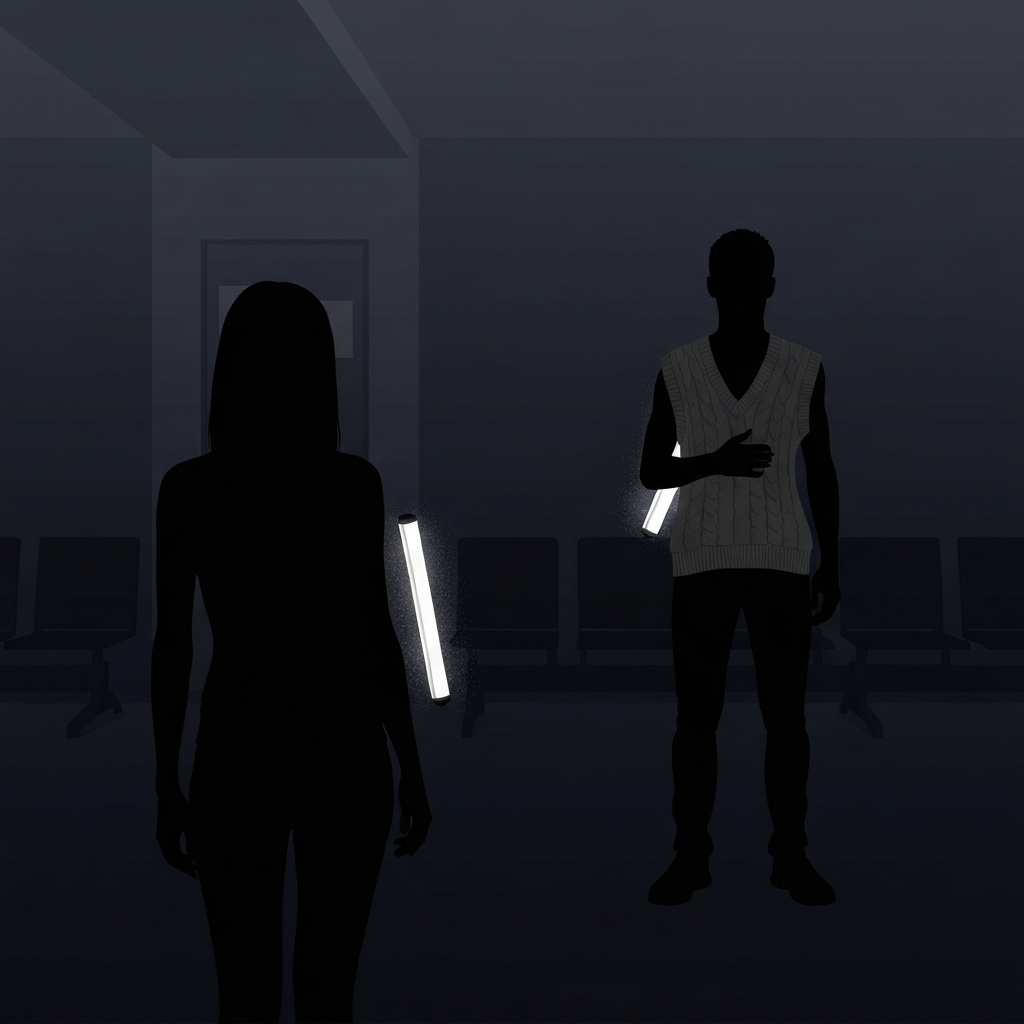
“Wait here. I’ll be right back.”
Under the recovery room’s lurid pink light, Ji-su sits on the floor in her hospital gown. Ten minutes ago her lover had been beside her; then, coolly—“You should rest a little longer”—vanished. Nothing more serious than micro-vascular suturing, hardly open-heart surgery.
With trembling hands Ji-su pulls out her phone. Still not blocked. The last message sits unread. Still, I mustn’t leave. He might come back.
A body temperature slipping away
The waiting room is longer than she expected. Red vinyl chairs, one fluorescent tube stuttering. Ji-su clutches a brown leather bag. Inside lies the lover’s knitted vest, still carrying the ghost of chamomile from the nape of his neck.
A nurse steps in. “Your escort can leave now.”
Ji-su averts her eyes. “I’ll rest a little more—still dizzy.”
She is not ill. She simply has to stay. Knowing he may never return.
Whose room is the waiting room?
We often dance lasciviously on the traces of the absent. The question Does he know I’m still here? stops being sorrow and becomes a private authority.
Lingering in the space someone left is not mere reluctance. It is the furtive elation of the survivor—an alloy of possessiveness and inferiority—after the relationship’s formal end. A vicious compliance that manufactures proof, not of I’m fine without you, but of I still can’t be without you.
I become the most inconspicuous chair in your room. When you return, I will show you for whom I waited.
First case: Se-jin’s wardrobe
While her husband is on a business trip, Se-jin sleeps with his wardrobe door open. Not empty clothes—worn clothes: shirts salted with sweat, a sweater armpit-whitened by friction. Every morning she buries her face in them, inhaling. Before he returns she sprays the wardrobe with perfume.
This is evidence that I cared for you while you were gone.
He comes home knowing nothing. They share an unremarkable kiss at the door. But Se-jin knows: she has kept this room for him.
Second case: Min-jae’s kitchen
After the breakup, Min-jae keeps using the ex-boyfriend’s favorite coffee cup. He remembers the tiniest details—how many sugars, the way he pressed his lips together while stirring. Each morning Min-jae brews on the ghost of that ritual.
One day the glass shatters. Pale, he gathers every splinter, stores them in a small box at the back of the fridge.
Now he can never return. But I can still prove he was here.
Why are we drawn to this cruelty?
Psychologists call it post-rupture attachment: the delusion that by owning the relics we own the vanished. Not nostalgia, but a covert attempt to keep governing the other through relational debris.
As long as I keep your remains, you can’t leave.
We are terrified of filling the empty seat with ourselves. So we turn the absence into our room, a clandestine staging to reveal, when they return, how faithfully we kept watch. Not love—taming the ghost of love.
I stand against the coldest wall of the room you left. When you come back, I will show how long I waited, how perfectly I preserved your traces.
Are you still in that room?
Ji-su finally leaves the recovery suite. Yet the lover’s vest rides home in her bag. She hangs it in the far corner of her closet, secretly, and each morning brushes its collar with her fingertips.
Whether he might someday return, or never, is beside the point. What matters is that she is still the guardian of this chamber of traces.
Why do we linger in the vacancy left by the departed?
Perhaps we fear the vacancy will become our own room. So on the ruins of the other’s absence we domesticate ourselves—so that, should they ever come back, we can say: This room was kept for you.
Are you still inside his room? Or has your room been built upon his remains?