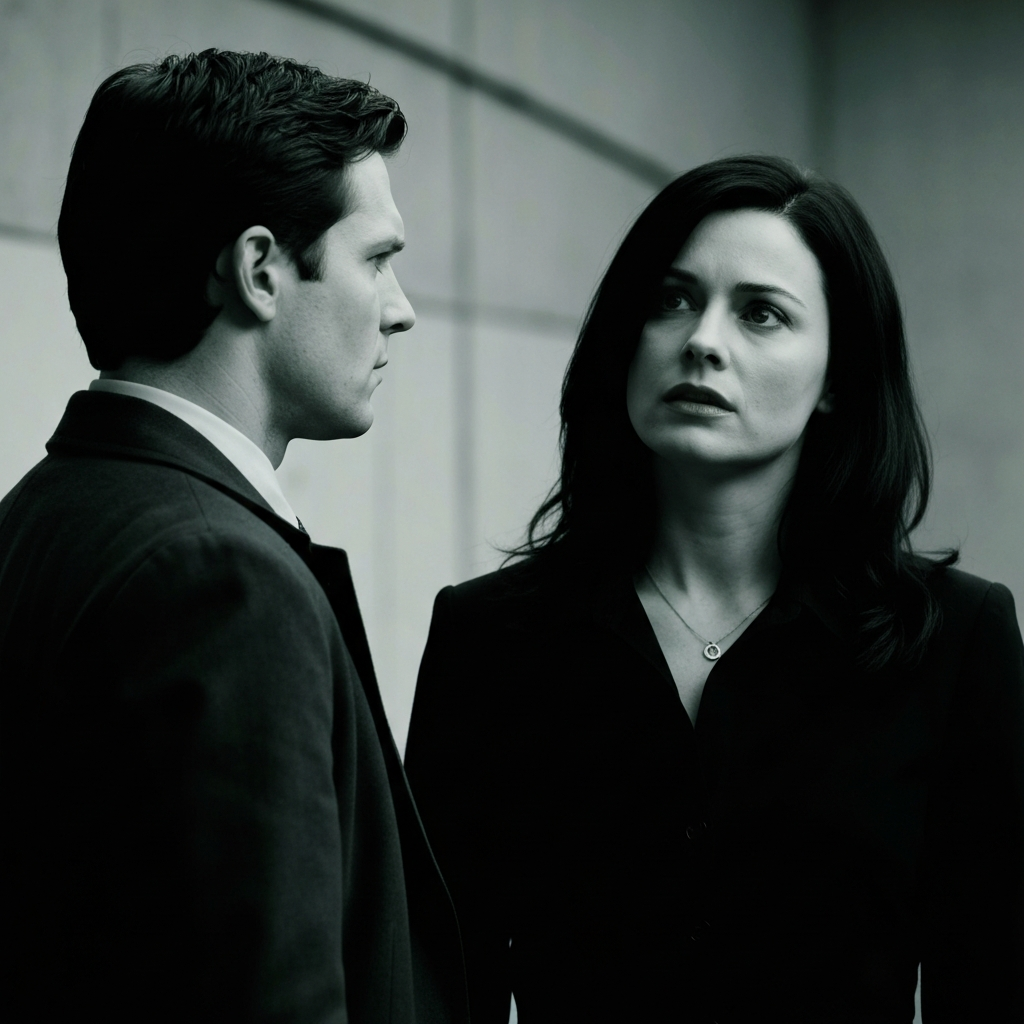
A note taped to the door, the red paint still dripping: Unicorn Hazard.
Juhye could have ripped it down and shredded it. Instead she licked the crimson smear from the back of her hand. A metallic sting pricked her tongue. She liked the taste. Or rather, she knew the taste spelled trouble.
May I open it?
The door was hidden at the foot of the basement stairs, past the emergency exit, where thin ice glazed the concrete. Steel handle, frost blooming like down on its surface. The moment her fingertips brushed it, the frost melted and tried to swallow her whole. It felt less like gripping a door than like the door gripping her.
Curiosity unbridled, a beast with the reins chewed through
Why is it that even when we recognize danger, we can’t look away?
“You know this isn’t mere curiosity.”
Unicorns. There are no biological unicorns, of course. Yet everywhere there are creatures that seem untouchable, that would shatter at a touch: the married man, the teacher, the boss, your friend’s fiancée. Different labels, same scarlet lettering scored across their skin.
Behind this door waits a version of yourself you will not survive.
The door stands between the fate of being rejected and the fate of being unable to refuse. The crevasse between them is what we call desire.
One week later, Juhye was stepping out of her tailored suit
“Shall I start with the trousers?”
He said nothing. Simply walked up beside the jacket hanging on the wall and peeled off a plastic tag.
KIM JUNHO, MD.
A hospital ID. While he undid the bow of her apron, the eyes in the photo still looked kind.
She never called him a unicorn. He was her dermatologist. For eight years, from the very first consultation, he had known every sensitive point on her body. The sight of him biting the end of his pencil while reading the words “blister scar” or “itchy spot” on her chart had stayed etched in her mind for eight years straight.
In that time she had married and divorced. He had delivered his first child. They had always existed inside the small, sterile box labeled “exam room.”
Then one day, at the end of an appointment, the paper envelope he handed her contained a black note.
Emergency exit, basement, 9 p.m. I’ve prepared a medicine money can’t buy.
It was no medicine at all.
The second unicorn: Dohyun, who only kissed
Dohyun worked in ethics for a public agency under the Ministry of Culture. A professional glass-polisher, in effect. Embezzlement, sexual assault, workplace bullying—he spent his days scrubbing other people’s filth. And every night he rode the subway home on Line 3, past Gwanghwamun.
The announcement over the speakers: “…Passengers, this train will stop two hundred meters past the terminus. Please disembark.”
Dohyun did not disembark. Through the window he saw a woman standing in the dim light. On her cheek glinted a crescent-shaped scar. He had seen that scar hundreds of times in ethics-training photos. “Victim A, workplace harassment.” The name had been redacted, but he knew her real name.
From that day on he began riding past the terminus. The woman wore a different outfit each time—skinny jeans, nurse’s scrubs, gym uniform. She seemed to be waiting for someone. When Dohyun approached, she spoke first.
“…You know you’re not supposed to get off here, right?”
He nodded. And still took one more step.
Neuroscientists call it a dopamine mirage
Taboos come in two flavors:
- Primary taboos—what society forbids.
- Secondary taboos—what we ourselves label “never.”
A unicorn stands at the intersection of both.
- Social ruin is already foretold.
- Personal ruin has already begun.
Yet we open the door for another reason altogether: the terror that we ourselves might shatter.
The unicorn wants not you, but a shard of you. Hand over the shard and you are no longer whole. In exchange for incompleteness you receive the gift of melting.
“Whom should I be holding?”
When Juhye came back up and closed the door, she saw her husband at the end of the corridor. He was holding a hospital envelope. Inside: a single photograph. The back of Juhye seated in a chair, a man’s lips pressed to her nape. On the reverse, in red pen:
YOU KNEW.
Dohyun stayed on the train past the terminus. A colleague came looking for him. Just before the doors shut, the man slipped a card into Dohyun’s breast pocket.
Summons to the Ethics Committee.
Can I close the door?
Or must I?
No—do I even want to?