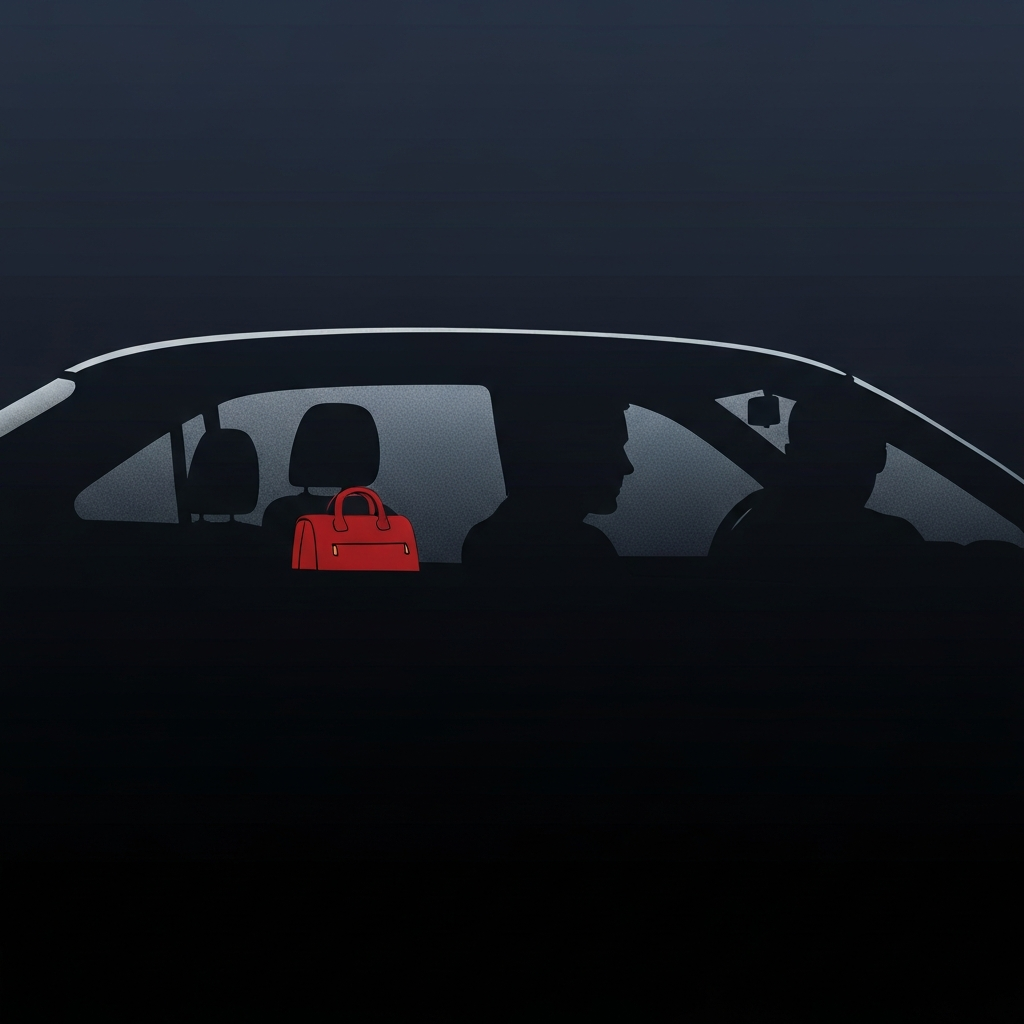
“Sleep well—I’m taking the van.”
Perched on the edge of the bed, cigarette between her lips, wearing only a T-shirt, she spoke. 3:42 a.m. We had lain as far apart as two bodies in the same mattress could manage.
“It’s too warm in here—I’ll never fall asleep.”
It was an excuse. I knew it. She waited until my breathing slowed, then slipped out to the van and touched the thing she kept hidden: the red envelope on top of the fridge, the one I’d once brushed against and watched her snatch away. The door clanked shut. I pulled the blanket over my head.
For five years now she has slept not in anyone’s bed but inside a 2003 Starex.
The You Inside the Bag
Her trunk holds a small red carry-on, padlocked and rust-stained, handle long since snapped. She has tried to throw it out countless times; every time her hands shook. Inside are these things:
- the cream cable-knit pajamas I gave her the first winter
- a Polaroid from the day we began dating—faces half-dissolved, only one side still visible
- the birthday card I wrote: I want to grow old with you
- and a sonogram from the seventh month
I never saw the last one. She went to the clinic alone; when she came back it was already too late. I sat on the bathroom floor and cried. She lay on the bed staring at the ceiling. After that night we touched each other’s bodies again, but we never held each other.
In truth we both knew
We both knew the bag was there. I saw what she slipped into the envelope; she knew I saw. We never spoke of it—not to protect each other, but to keep the wreckage hidden.
We met a few nights ago at the corner convenience store. She hadn’t changed—black hoodie, a single can of beer trembling in her hand. I looked at her and said,
“Still living in that van?”
She gave a small laugh. “Yeah. It’s home now.”
The back seat was chaos—shampoo, blanket, a half-eaten kimbap roll, and the red bag. I pointed.
“Still…”
“I can’t throw it away.”
Two fairy tales
Min-ji’s story
At twenty-seven Min-ji broke up with her boyfriend three years ago. The reason was simple: she was pregnant and he did not want the child. She went to the hospital alone. She kept the small surgical wristband and the sonogram she was given afterward; she couldn’t discard them. For three years they have lived in her glove compartment. People tell her, Just throw it out. Min-ji knows it isn’t an object; it’s the ghost of a time she had to kill.Jae-hoon’s story
Jae-hoon still keeps his ex-girlfriend’s necklace in the cup holder. A tiny gold key, now dulled with rust. She had said, This is the key to the future we’ll open together. Five years since they parted, Jae-hoon lives with someone else. His wife has begged him to toss it, but he knows the necklace is not mere jewelry—it is the wreckage of a future he once believed in.
Not luggage—corpses
We bury the bodies of our love in cars. The inability to discard is not simple obsession; it is a wake. A vigil for the time we murdered together, or allowed to die—the possibilities, someone’s future. A car is a sealed chamber; close the door and the world stops. That is why the unbearable truth is allowed to breathe there.
For some it is a red bag; for others a necklace, an old photograph. This is not preservation. It is a funeral. A small funeral held in the backseat.
What lives in your trunk?
Have you ever parked and opened the trunk to look? If something is hidden there that no one must see, it is a past still alive. And you will probably never throw it away—because it is not a thing; it is the corpse of a time you still love.
Somewhere tonight she sleeps again inside that Starex, a whole universe contained in one van. And perhaps all of us carry something we have never fully buried.
That object you keep hidden—ask yourself: is it luggage, or is it the past you are still trying to keep breathing?