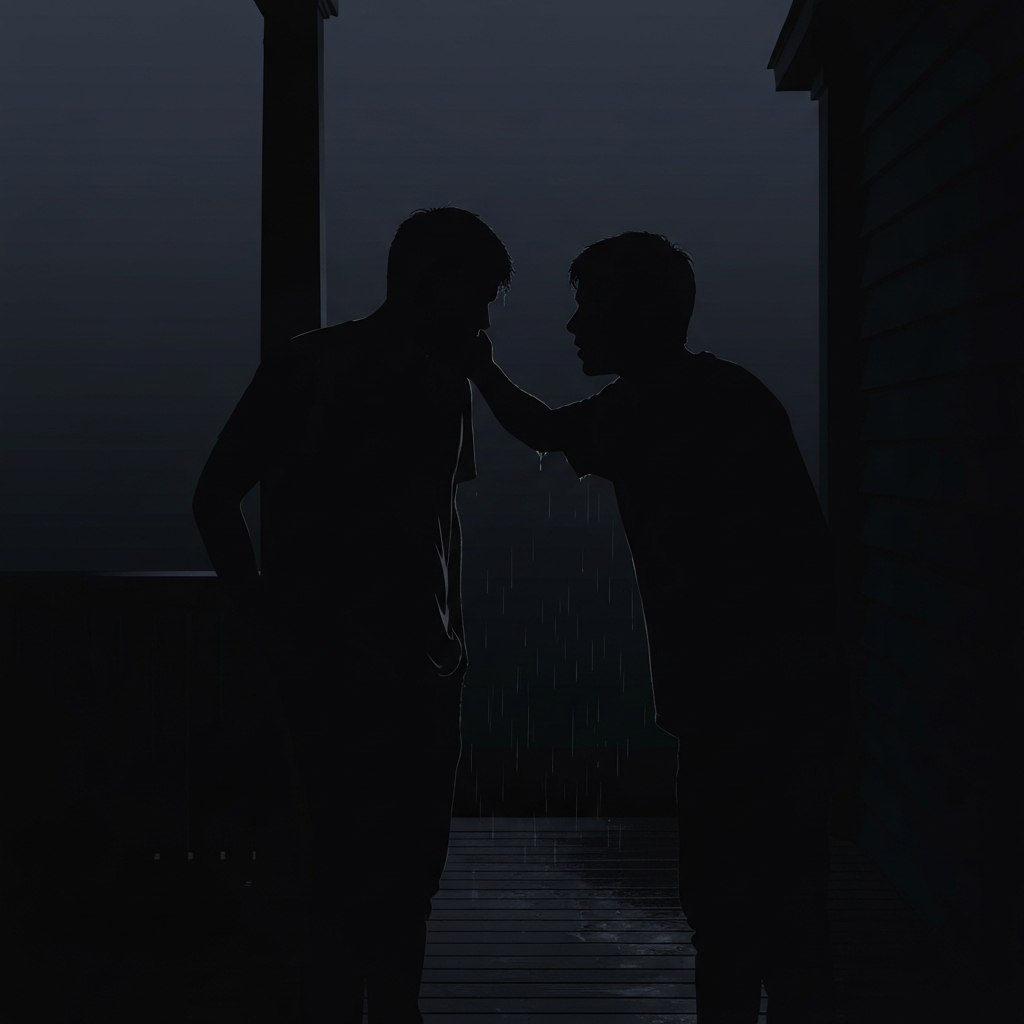
"Hey, what’s going on between us?" "Look out the window—it’s raining." Junho rested his elbows on the sill. The shoulders of his white t-shirt were soaked, exhaled the faint perfume of fresh laundry. I sat on the edge of the bed and inhaled, greedy for that smell. Is it all right simply because we’re cousins? Or does the very wrongness make it sharper? ——— ## Thoughts as briny as seawater We had an official story: grew up like siblings. And until elementary school, it was true. But the summer of high school, everything cracked open. The moment he grew tall. Julia remembers it precisely. Seventeen, Seoul heat, Junho arriving at the country house from the city. He’d stretched ten centimetres, and his gaze had changed. The mischievous cousin-brother vanished; a faultless stranger remained. He pretended not to notice, but Julia knew what she couldn’t hide. ——— ## Practising escape "Let’s go out. It’s stifling here." Julia stood first. Junho saw it—his cousin-sister avoiding his eyes. As soon as the door shut, the air loosened. A mistake. Outside, a darker scent rose: rain-soaked earth. A body grown from that earth. ——— ## Shameful surf That night Julia was alone. Parents, uncles, aunts—everyone had gone to the village festival. Junho? He stayed. "Why didn’t you go?" she asked from the entryway. "Not my thing," he said. He sat on the sofa; the television was mute. A silence thick as midsummer. This is wrong. Julia thought it, but her body disagreed. She sat beside him, one cushion between. "Do you… have a girlfriend?" The words leapt out. Junho laughed. "Why ask suddenly?" "Just wondering." That just wondering carried too much. ——— ## The flavour of taboo Psychologists say taboo is desire’s catalyst. Why are we stirred by imagining cousins—relatives within four degrees? Because the absolute no sharpens the what-if. If only we weren’t cousins. The fantasy itself is vertigo. Social taboo passes through two stages: first, the unconscious (barely aware); second, the conscious (we’re family). Cousins hover between—known yet not quite. That ambiguity is the narcotic. ——— ## Second summer A year later, they met again. Julia eighteen, Junho twenty-one. A family trip to a Seoul pension. "Come down when you’re ready for dinner," the parents called. Julia lingered deliberately. Junho was already on the terrace. The evening air was thick. "I still don’t know why I did it," Julia said. Junho said nothing. He only brushed a strand of hair from her face. This isn’t the end. They knew—no, felt it. ——— ## Taboo resonates We often think of family as sanctuary. Yet the closest ground can be the most dangerous—because there is no distance. Cousins stand on the border: family, yet not quite. That contradiction pricks instinct. Robert Kennedy called taboo “the crossroads of fear and desire.” We stand at that intersection and watch ourselves. How far can I fall? And then, secretly, savour the falling. ——— ## Final question That night in the pension room. "What… happens to us now?" Julia whispered. Junho didn’t answer. He looked out at the sea. But the sea wasn’t dark. It mirrored their desire. And you? Haven’t you, at least once, looked at someone hidden beneath the word family? In that moment, how deep did you want to go?
← Back