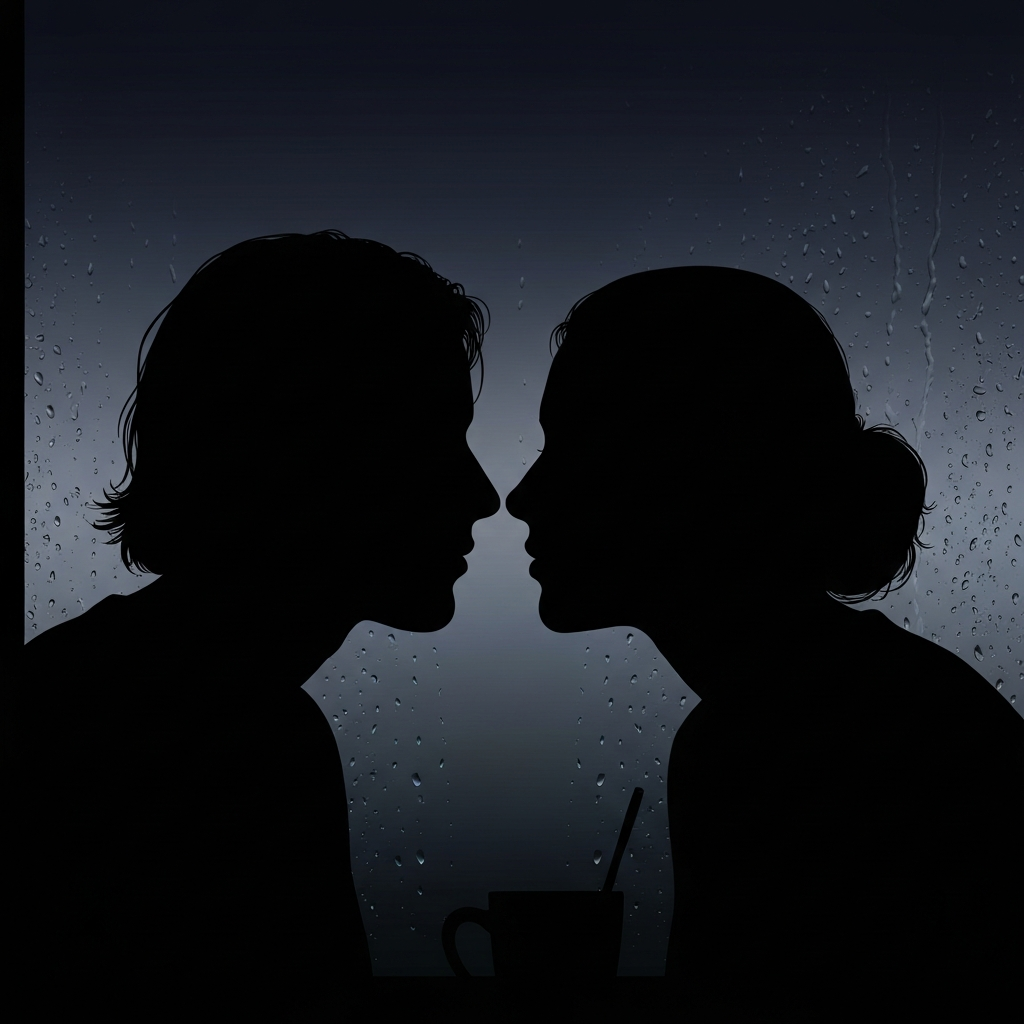
Rain speckled the café window. I waited, hair still dripping, for him to arrive. When he finally walked in—fifteen minutes late—my body reacted before my mind. A single droplet clung to the nape revealed beneath his black coat, and something coiled inside me.
“Sorry, the subway was—”
The instant his breath grazed my cheek, I was already looking at a stranger. The hair plastered to his temple, the way he spoke—they did not belong to the Ji-hoon I had sketched in my mind. My Ji-hoon was always immaculate, smelling faintly of warm hair-dryer and cedar. Instead, his coat exhaled the raw, unmistakable scent of wet wool and cigarette smoke.
That night, while he was in the bathroom, I peeked into his coat pocket: a crumpled tissue, a coffee-stained receipt, and the faint ghost of an unfamiliar cologne. Each item announced a quiet apocalypse. Yet I already knew: the person I loved was never him, but a silhouette I had sculpted.
We never loved another’s living flesh; we loved the negative space we believed that flesh would fill. One-eighty tall, eyes that smile before the mouth, someone who reads my silence—each criterion was my private equation. Hidden inside it was a monstrous desire: to have him caulk the holes I could not. Solitary dinners, movies watched alone, night streets where only my footsteps echoed—those voids I wanted him to fill. That night I understood.
Case 1: The ‘Sang-hyeon’ Yuri Invented
Yuri, 32, advertising agency AE, recalls their first meeting:
“When Sang-hyeon handed me his business card, his fingers were beautiful—nails exactly the shape I adore, veins taut across the back of his hand. So sexy.”
She remembers the day he arrived with yellow roses—her yellow roses. It was no accident. He’d back-tracked through her SNS and found a photo she’d posted three years earlier. Second date: the cinema she’d once mentioned. Third: the precise wine she favored.
“But on the fourth date, when a waiter spilled the wine, he snapped. Veins bulged here—” she touches her throat. “It looked alien. The Sang-hyeon I created would never get angry like that.”
Case 2: The ‘Real Me’ Jun-ho Hid
Jun-ho, 29, software developer, confesses:
“My girlfriend thinks I’m calm, rational. Truth is, I’m anxious dozens of times a day. She believes I cook for fun, but that’s just one plate of pasta recycled in photos.”
While she sleeps, he sometimes locks himself in the bathroom and cries.
“She thinks I’m warm but emotionally clumsy. I’m not warm; I’m just lazy about showing anything else.”
We weren’t hunting for the perfect puzzle piece; we were hiding from the imperfect self who cannot bear reality. When we say I love you, we are already plotting revisions. Psychologist Donald Winnicott spoke of the false self: we love not the actual other, but our inner representation. The real man can never become the ideal type for the simplest reason—the ideal type does not exist. It is only the shadow cast by our own lack.
That night Ji-hoon stayed over. While he slept, I cautiously touched his hair. It was coarser than I’d imagined, sometimes stiff with dried product. The Ji-hoon I invented had silken, fragrant strands. I brushed my lips across the back of his hand—sweat, soap, and something indelibly male.
In that moment I understood: I might come to love this scent—imperfect, nothing like my fantasy—the scent of an actual man.
When you say you love someone, do you love the person? Or are you angry because they fail to fill the fiction you created? Perhaps we are all fabricating a counterfeit man, a counterfeit woman. And only when the counterfeit shatters do we stand on the threshold of real love.
Since that day, whenever Ji-hoon’s silhouette wavers, I quietly close my eyes and remind myself: within that tremor the real Ji-hoon is breathing—and I may grow to love him.