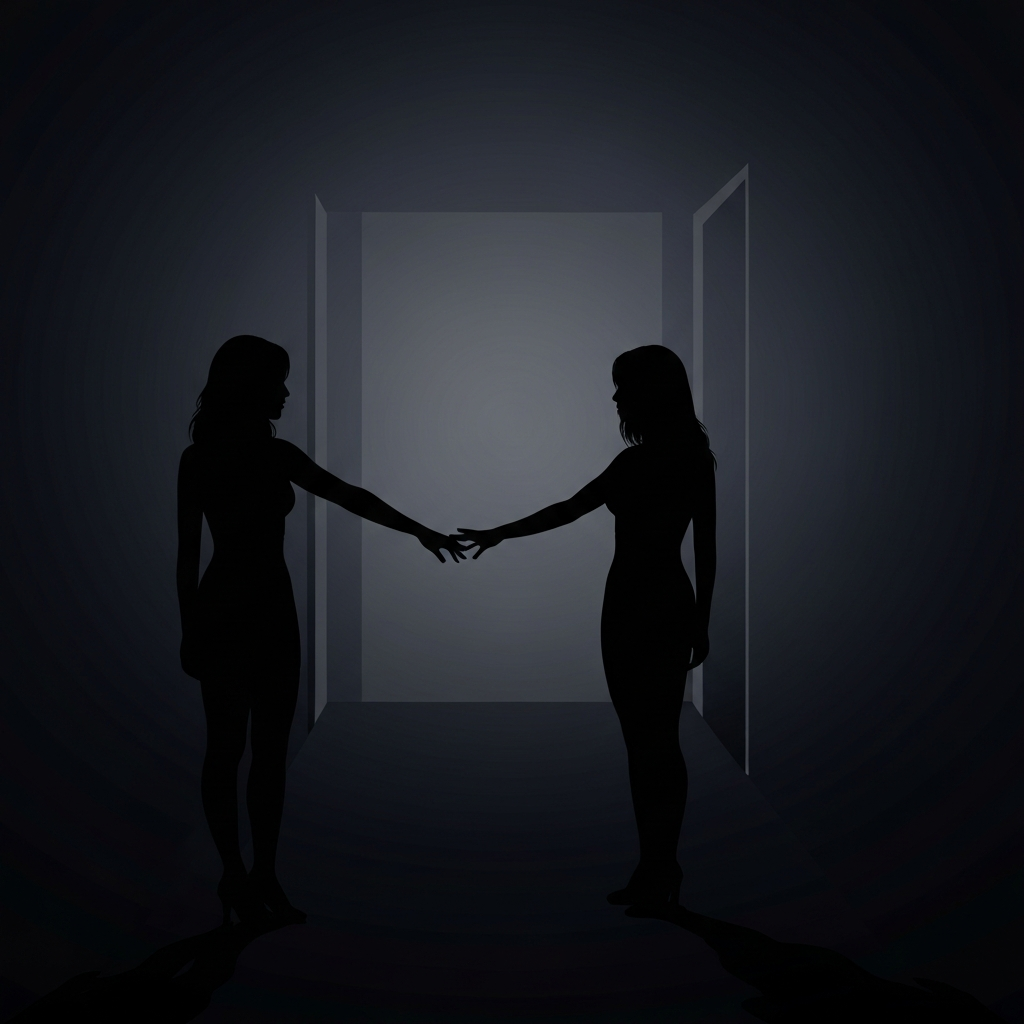
“They say she did nothing wrong.”
I still haven’t forgotten those words. A single photograph on his phone: she stood barefoot in a black minidress, cigarette between her teeth, smiling beneath the basement parking lights. I imagined that mouth exhaling smoke—then licking my lover’s neck once more. The same night repeated itself. I fired off texts in rapid succession. Why is it that she bears no blame? Silence answered. Instead, his broken watch rolled across the desk, forever stopped at 11:17—perhaps the moment he left her apartment. I pried out the minute hand and spun it between my fingers until its point pierced my skin.
Something Stirring Beneath the Heart
Was she truly innocent? Or was I terrified of the possibility that I had wanted her, too? Hidden desire looks like this: a bruise of rage blooming like smeared rouge, a dream twisting between sticky jealousy and impossible tenderness. What if it were her shoulder beneath my palm instead of his? What if she took my wrist and smiled? The thought is ghastly, yet inside it I tasted a calm more terrible than orgasm.
I hate her. That is why I imagine her. Through her, I hate myself.
Subway Line 4, 23:58
Every night Ji-hye rode the same route. Jongno 3-ga to Seongsu, exit 2 at Gwangjang, three hundred meters to the studio where the woman lived. At the start of the year, Ji-hye’s boyfriend left her. The reason was simple: I’ve fallen for someone else. Ji-hye went to the woman. Words turned to quarrel. Yet at the end Ji-hye asked, Have you ever—however briefly—felt drawn to me? …For a moment, yes. At that confession Ji-hye pulled her close—not to kiss, only to breathe in her hair, the way one tests a perfume, grazing an earlobe with her teeth. The woman recoiled; Ji-hye smiled and turned away. Since that night Ji-hye keeps vigil outside the building. She photographs the woman’s frowning silhouette, filling her phone with images she will never post.
I love her. The woman who stole my man—so that I, too, may steal her.
Shadow at the Masquerade
Su-jin, thirty-two, a banker, never learned the name of her husband’s lover. She knows only the dawn of March fifteenth, when she found a single pair of socks he had brought home—pale beige, a red scrawl on each heel: Layla. Su-jin began to dream Layla into existence. Scarlet nails, knees flashing beneath a short skirt. Astonishingly, she enjoyed performing her. When the husband returned, Su-jin stepped into the living room wearing the beige socks and spoke in Layla’s voice. I did it the way you like tonight. His face drained of color. …I’m sorry. Su-jin tormented him as Layla, then cradled him as Layla, until she no longer knew who she was. One night she texted him from Layla’s name: I want to see you again. The reply came at once. Me too.
The Back-Alley of Taboo
Why do we covet the rival? Not mere revenge, not simple jealousy—something more. A taboo is always a mirror: it shows the self inside the self. The instant I desire the woman he chose, I am in truth regarding my own desire. The psychologist Carla Laurence says, Obsession is not an attempt to dominate another but to dominate oneself. Through the rival we test how far we can fall, how soiled we can become. So we imagine her imagining us: that she wants me, that she aches to hurt me, too. Only in that fiction can we modulate our wounds—becoming neither villain nor victim, only the self made possible.
Whom Do You Want More?
Right now, whom are you picturing? The woman he slept with? Or the woman you might become? A knock sounds at the door. No one will be there. Yet you are already turning the handle. Outside, no one waits, but inside, she is already you.