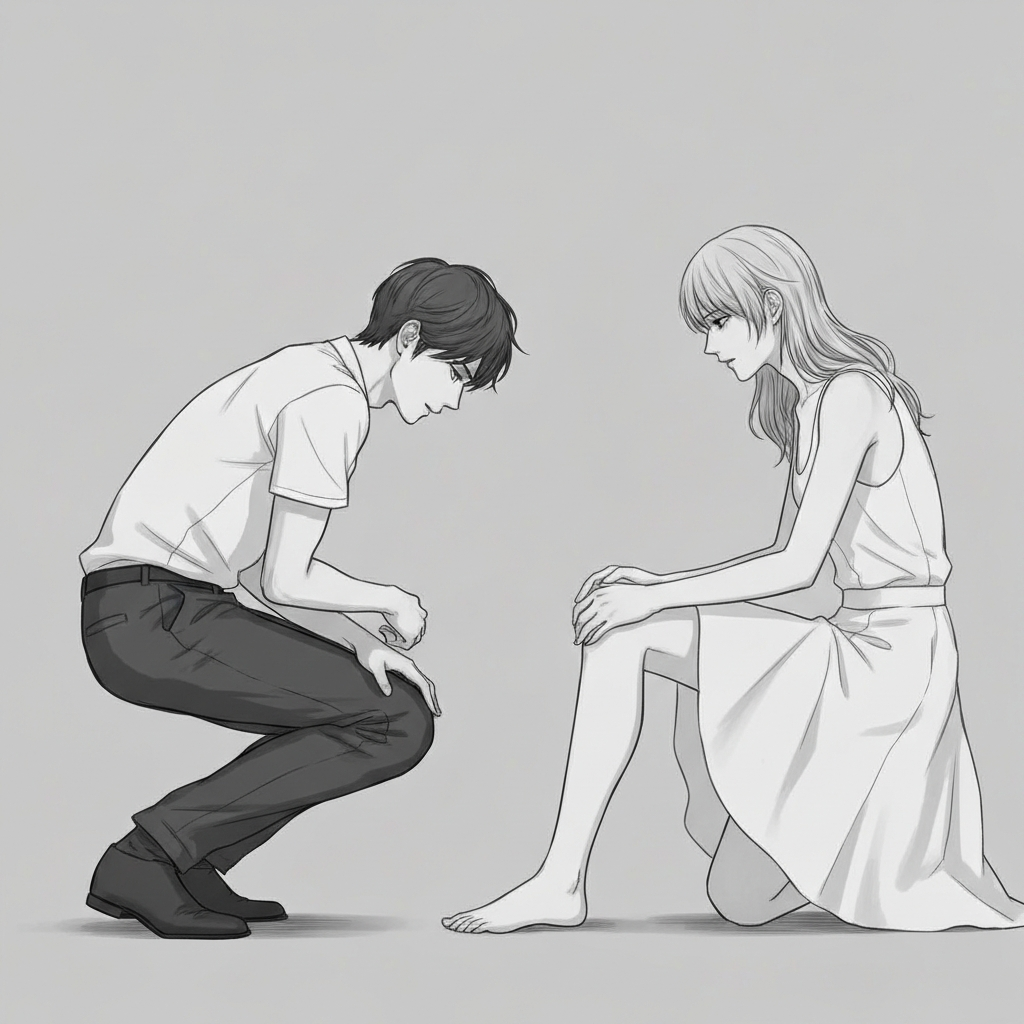
Thud.
"Break up with him."
Joon spoke—or rather, commanded.
In the corner of a bar, beneath the nicotine-stained lights, he said it while I was holding Jisoo’s hand. I laughed, sure it was a joke. But Jisoo lowered his head, and Joon repeated himself, slower, deeper.
"You’re ruining him."
At that, Jisoo’s hand slipped free. I looked into his eyes; the answer was already there. Instead of I’m sorry, he pressed his lips shut.
That was our ending—wordless, on the spot.
Why the Mouth Would Not Open
Why didn’t he speak? Why didn’t he try to keep us? Or rather—why couldn’t he?
Joon is my high-school friend, the very one who introduced me to Jisoo. He has always been the hyung—first to drink, first to travel, first to throw a punch. Around him, Jisoo shrank. When I asked, “What are you two, really?” Jisoo would only smile.
There was something in that smile.
I learned later: Joon was Jisoo’s first love. He confessed, was refused, and lingered as an oppa. Then I appeared. At first Joon liked it—“Take care of our Jisoo,” he laughed—until he saw Jisoo take my hand. His eyes changed.
The Vanishing Dialogue
“Seeing each other too often, aren’t we?”
“Don’t wear that.”
“Why the drinking again?”
Joon’s remarks sharpened. Each time Jisoo defended himself—“I do it because I like it”—but the words never reached Joon. He knew Jisoo’s weak spots: an abusive father, a mother who ran away, the nights left alone. He used them.
“Going to get hurt trusting someone again?”
At first I didn’t notice how Jisoo sent Joon daily Kakao logs of his life, how if Joon merely replied “k,” Jisoo would call: “Did I do something wrong?” Without Joon’s approval, Jisoo couldn’t last a day. Joon knew it and used it. And I, watching, said nothing. Why?
Because a small, ugly fear whispered that Joon might be right.
Other People’s Silence
Minseok, twenty-nine, works at a gaming company. His girlfriend Hye-jin lives with her best friend Su-jin, who knows everything—ex-boyfriends, family mess, even Hye-jin’s sexual preferences.
“Su-jin says she doesn’t like you,” Hye-jin muttered over a drink.
“Doesn’t like what?”
“She says you’re too clingy.”
Minseok laughed. Clingy? He had watched Hye-jin message Su-jin ten times a day—lunch, outfits, what her boss said—consulting Su-jin before him. When he asked, “Why not tell me first?” Hye-jin answered, “Su-jin’s known me longer.”
Minseok met Su-jin alone.
“She leans on you too much,” Su-jin said, sipping her iced americano.
“So change it.”
“How?”
“Leave. She’ll manage without you.”
That night Minseok told Hye-jin he was leaving. She cried—then immediately called Su-jin.
“Minseok wants to break up—what do I do?”
“Good. It’s better for you,” Su-jin said.
Hye-jin nodded at the verdict, and Minseok stood mute, unsure whether Su-jin was right or terrified that Hye-jin had chosen her.
What if she never chose me at all?
The Root of the Taboo
Why do we hesitate even in love? Why does another’s “This is wrong” sway us?
Psychologists call it social proof. Humans dread exile; romance is no exception. Friends, family, colleagues—our choices bend under their gaze. Women feel it more fiercely: evolutionarily, banishment equaled death, so they instinctively seek the man other women approve.
Yet men are not immune. Minseok’s fear—What if I can’t outrank Su-jin?—is no mere defeat; it is the terror of the unchosen man.
Joon felt it too. He could not bear that Jisoo had found someone “better,” so he destroyed it first: This isn’t love. And Jisoo bowed, to survive within Joon’s world.
A Final Question
We each meet our own Joon, our own Su-jin. The instant we say I love you, someone turns away—“Really?”—and our mouth is already shut.
So I ask: before whose silence, without whose permission, have you abandoned love?