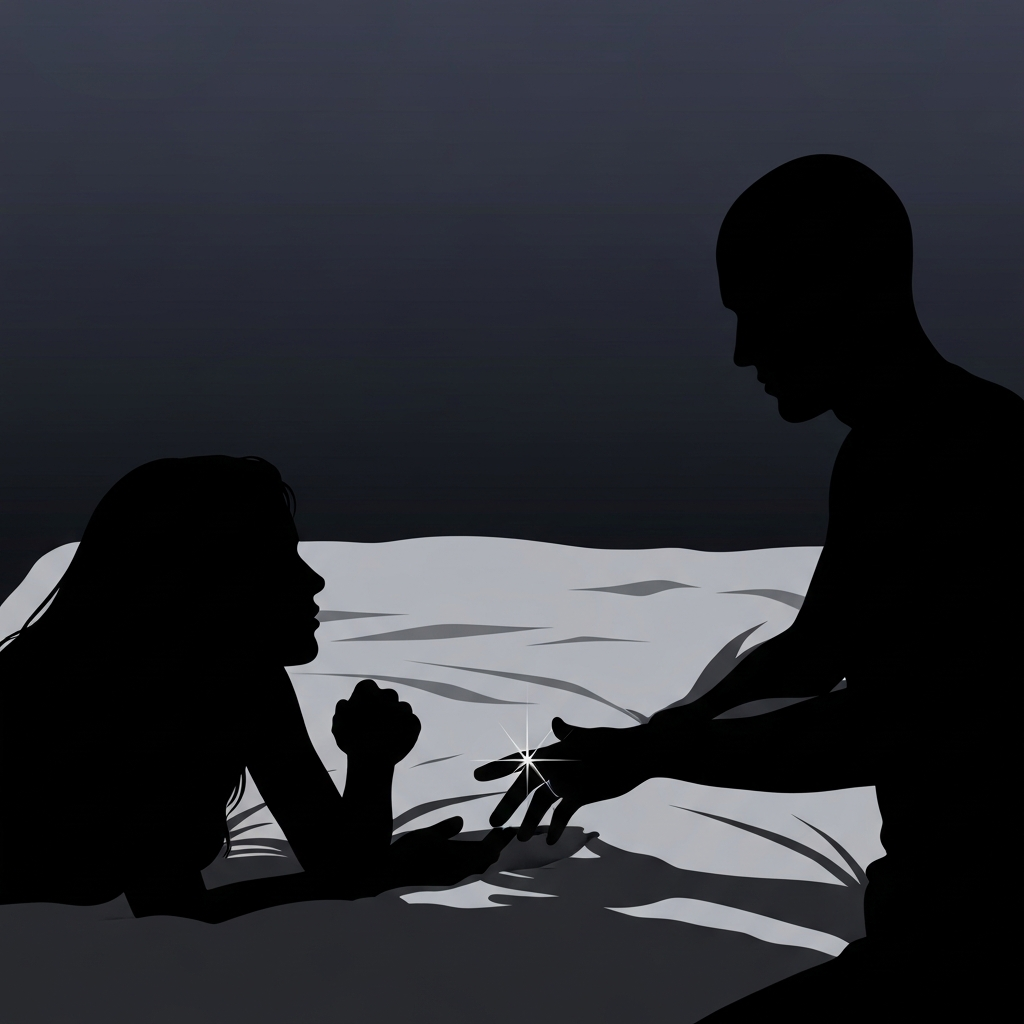
“Take a picture. My wife will never set foot here.”
“Shall I lie here?”
She crept onto the white sheet, quiet as a secret. Her shoes were off, but the black stockings stayed on. The faint scrape of heel against cotton sounded like someone whispering in the dark.
He raised his phone—not the camera app, just the raw lens. Flash off. The room was lit only by the thin hush of afternoon light and their two uncertain breaths.
“Here.” She stacked two pillows beneath her head. When she let her hair fall and lay back, the skirt rode up to mid-thigh. The contrast of black nylon against the flawless white was so sharp it hurt to look at.
He took one step closer. The ring on his left hand glinted: a muted gleam mixed with the lingering scent of car upholstery and cold coffee.
Perhaps to preserve this moment in a photograph is to lose something forever.
The unspeakable fantasy even in dreams
The woman in the picture is not his wife. Yet the white bed, the morning light, the drowsy gaze—all of it looks bridal, as though the lawful wife, not the mistress, should have slept here.
Two desires overlap.
Her desire is for substitution: not to become the wife, but to replace her.
His desire is for superimposition: to have extra, to fill the wife’s portion and still hunger.
The photograph is the precise intersection of those two hungers. Intersections, however, always end in wreckage. One woman claims the space in the name of family; the other, in the name of taboo. The space is singular, and time always arrives too late.
“Ah—here? What day is it today?”
Ji-eun, 32, marketing team lead, took that picture on the second Saturday of last May, in a Gangnam officetel on the 14th floor. Her superior was Young-jun, 45, deputy general manager: twelve years married, wife a corporate lawyer, father of two.
After a workshop that ran until dawn, she climbed into his car.
“Where are we?”
“Company apartment. Let’s sleep a little before we go.”
“…You shower first.”
When she came out, he was already on the bed, two buttons of his white shirt undone.
“Let’s take one shot. I think I’ll want to remember this.”
She obeyed. The mingled smells of body lotion and wet hair filled the air. No flash fired, yet in that instant of darkness she felt something being taken from her that could never be returned.
The moment the ringed hand clenched the sheet
Another case. Soo-jin, 29, intern, traveled with her boss last winter. A pension in Gangwon-do, snow heaped on the balcony railing, a white bed inside. She pretended to sleep. While he stepped out, she slipped his wallet from his coat and drew out a photograph of his wife—handsome woman, pretty children. Quietly she laid it on the white sheet.
This is your place. I’ll lie here in your stead.
Then she lowered herself over the picture and closed her eyes. When he returned he said nothing; simply moved the photo to the bedside table and stroked her hair. That night she dreamed the wife’s voice:
One day you, too, will have to leave this bed.
Why do we long to lie on the forbidden bed?
This is no simple tale of adultery. It is a question of mimesis. We mimic the wife’s place, her hour, even her scent. Yet mimicry is always inadequate; it is never the thing itself.
Psychologists call it the desire of absence. The less attainable something is, the more violently it is desired. A married man’s bed is the perfect emblem of that absence: a space where the wife is, yet the mistress is not. The white sheets magnify the yearning, staging every contradiction at once—purity and taboo, matrimony and trespass.
When the contradiction is fixed in a photograph, we doom our desire to be forever lost.
“Are you, too, picturing someone’s white bed right now?”
The photo is still in her phone—not on the lock screen, but in a hidden folder she opens now and then. Each time the same realization: the moment is fading to white, like the sheet itself, like a white lie.
Are you, this very instant, sketching in your mind a white bed with someone? And at the end of that imagining, do you truly want the bed—or the knowledge that you can never fall asleep in it?