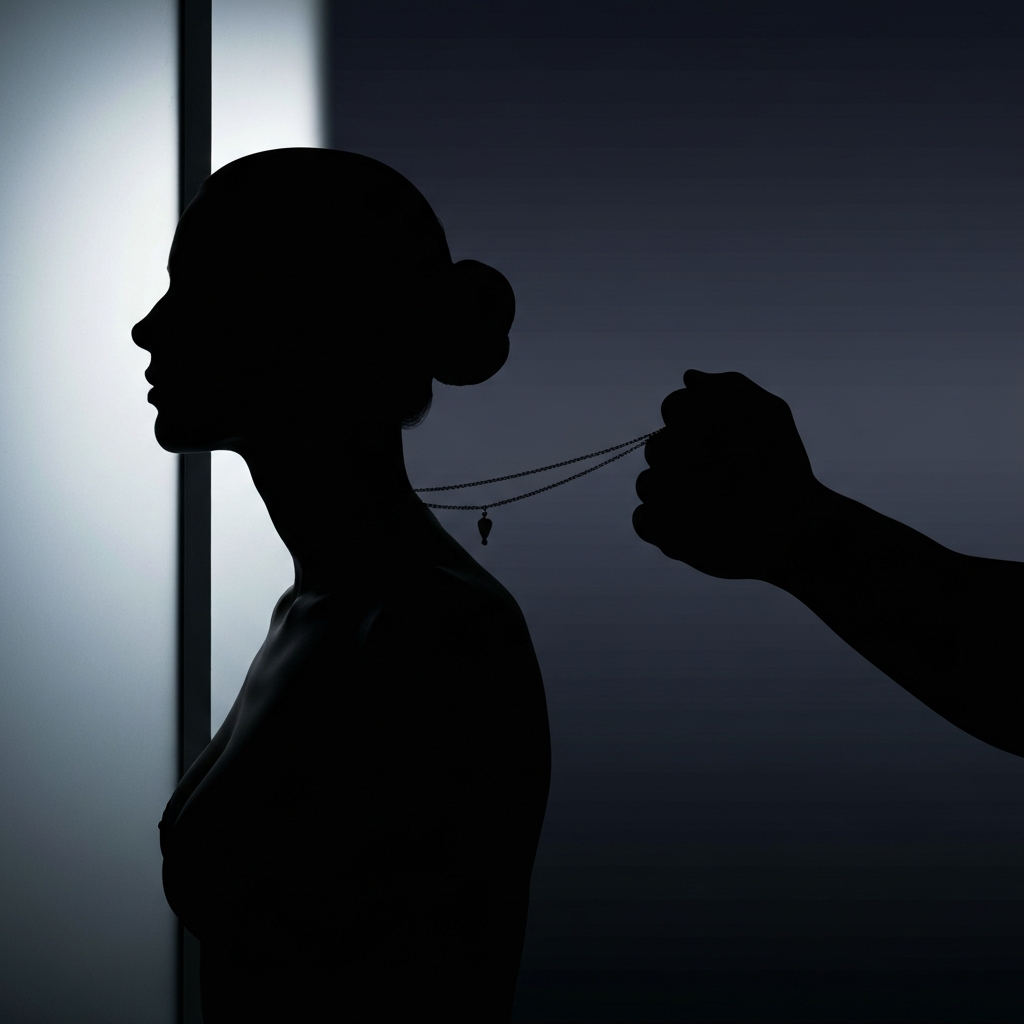
“Don’t squeeze it. You might drop it.”
The first time Ji-yeon laid the necklace in Seon-jae’s palm, I was nursing a glass of whiskey two tables away. Last autumn, Samcheong-dong wine bar. Seon-jae—her Pilates teacher—folded his fingers around the gold as carefully as if it were a crystal flute. A voice I knew too well floated over.
She’s handing the necklace I bought to another man. This isn’t a casual slight—it’s a declaration of war.
The Metal That Carried Her Breath
I understood from that moment: what Ji-yeon offered Seon-jae was never just a necklace. An 18-karat gold chain with a thick round pendant I’d chosen for our third anniversary. She used to say the cool weight against her nape calmed her. That night, though, she stroked the pendant and looked only at Seon-jae.
Is there a gesture more covert yet more brazen than surrendering a necklace? The instant metal leaves skin, another body’s heat replaces it—the tremor, the weight. As the object that guarded my wife’s throat slipped to the fingertips of another man, I sensed a narrative of submission beginning.
I knew I was crossing the boundary I was meant to protect—and still I turned away.
The Art of Making It Look Like an Accident
Two months later, Ji-yeon announced private sessions at Seon-jae’s studio. Too late for Pilates, but she left in a black hoodie. The back of her neck was bare. From that night on, she began leaving the necklace at home.
At first I thought it accidental. Twice a week, she set the gold on the duvet and walked out. At two a.m., she drifted in, half drunk, and showered. Between the splashes, a sound like laughter—was it real, or imagined? I lay on the sofa and studied her throat. Nothing.
Meanwhile Seon-jae began posting a series on social media: a close-up of a necklace against black velvet. #dailyobject #goldpendant. The tags were clinical. The fingerprints on the pendant looked narrow—clearly a woman’s thumb.
A Room Where Three People Breathe
I installed a hidden camera in our apartment one late November evening, the day I watched Ji-yeon return in workout clothes. She stood before the living-room mirror and stroked the hollow of her neck. Then she called Seon-jae. Speaker off, but the reflection of her lips told me enough.
“My throat feels empty tonight.”
The next evening, Seon-jae brought the necklace himself. I was inside the apartment. Ji-yeon glanced at the intercom screen and smiled. When she opened the door, Seon-jae stood with the chain in his hand. Ji-yeon lifted her chin, offering her nape. Seon-jae coiled the gold slowly, feeling the tremor of her shallow breaths. Thirty seconds—no embrace, no kiss. Yet in that moment I felt the three of us lying in the same bed, four lungs pulling at the same air, heads turned at matching angles.
The Cord of Taboo
Why does possession burn hotter once you lend it away? When Ji-yeon first entrusted the necklace to Seon-jae, her gaze flickered between delusion and fact. The moment the word belonging unclasped physically, she gained a new allegiance. Psychologists say the need to belong travels the same neural pathway as fear. When the cord loosens, the pulse beneath the jaw sharpens—and the question is who feels it.
Letting someone else clasp the necklace your husband chose is not trust; it is capitulation. When Ji-yeon comes home, I check whether a new metal glints at her throat—gift from Seon-jae or self-purchased, it hardly matters. What matters is that she has discarded my necklace.
What Still Hangs at Your Throat?
Last night I asked her, “Where’s the necklace?” She set her wineglass down. “Left it somewhere.” With those words our bedroom turned into an endless blank. She no longer circles her neck with anything; only bare air guards her skin.
And you? Does what hangs at your throat still belong to you—or is someone else’s fingertip closer?
It was never just a necklace. It’s the ruler measuring the distance between us.